Above the Valley: Where Thimphu’s Soul Meets the Sky
Nestled in the folds of the Himalayas, Thimphu reveals its magic not in crowded streets, but from quiet heights where prayer flags dance with the wind. I never expected such peace—standing atop a ridge, watching golden light spill over dzongs and forested ridges. These viewpoints aren’t just scenic stops; they’re gateways to Bhutan’s heartbeat. Let me take you to the spots where silence speaks louder than words. Here, elevation is more than a physical climb—it’s a passage into stillness, clarity, and a deeper understanding of a culture that measures wealth in happiness and progress in balance. For travelers seeking authenticity, Thimphu’s high places offer not only breathtaking panoramas but a profound recalibration of the soul.
The Pulse of a Himalayan Capital
Thimphu stands apart from the typical image of a national capital. There are no sprawling skyscrapers, no roaring traffic jams governed by blinking red and green lights—indeed, the city famously has no traffic signals at all. Instead, a uniformed traffic officer directs vehicles with graceful hand movements at the main intersection, a small but telling symbol of how tradition and modernity coexist here. The city pulses with a rhythm all its own, shaped by the flow of the Wang Chuu River, the turning of prayer wheels, and the steady beat of daily rituals that have endured for centuries.
Walking through Thimphu’s streets, one encounters a seamless blend of the everyday and the sacred. Women in traditional kira dresses carry woven baskets to the weekend market, where farmers sell fresh vegetables, handmade cheese, and wild herbs gathered from the hills. Nearby, young people in jeans and hoodies chat on smartphones outside a government office. Yet even in this quiet modernity, reverence remains central. Monasteries sit just above residential neighborhoods, their golden roofs glinting in the sun, while the sound of chanting monks drifts down with the mountain breeze.
What makes Thimphu a unique starting point for immersive travel is not its size or infrastructure, but its authenticity. Unlike destinations shaped heavily by mass tourism, Thimphu retains its essence because tourism here is carefully managed. Visitors must travel through authorized operators, and the government enforces a daily tariff that includes sustainable practices and cultural preservation. This approach ensures that tourism supports, rather than overwhelms, the local way of life. The real story of Bhutan unfolds not in crowded attractions but along quiet footpaths that lead uphill—toward stillness, clarity, and views that frame both landscape and culture.
For the mindful traveler, particularly those who value depth over spectacle, Thimphu offers an invitation: to slow down, to observe, and to connect. The city does not shout; it whispers. And those who listen are often led upward—toward viewpoints that offer not just sweeping vistas, but moments of reflection, where the soul of Bhutan becomes palpable.
Chagri Dorjeden Monastery: A Climb That Transforms
Rising above the Thimphu Valley at an elevation of 2,800 meters, Chagri Dorjeden Monastery is more than a scenic destination—it is a sanctuary of silence and spiritual depth. Founded in 1620 by Lama Gyalwa Lhanampa and later expanded by the great Drukpa Kunley, the monastery has long served as a retreat for monks seeking solitude and intensive meditation. The journey to reach it is itself a form of pilgrimage, a two-hour ascent through dense pine and rhododendron forests where the only sounds are the rustle of leaves and the occasional call of a Himalayan bulbul or laughing thrush.
The trail begins near the end of the road leading to the Cheri Goemba area, gradually winding upward through shaded paths and rocky outcrops. As elevation increases, the air grows cooler and crisper, carrying the faint scent of juniper and damp earth. This sensory shift marks the transition from the bustling life of the city to a space of contemplation. Few tourists make this climb, which helps preserve the monastery’s atmosphere of tranquility. Those who do arrive are often met with quiet smiles from resident monks, who move through their daily routines with unhurried grace.
At the summit, the monastery sits nestled against a steep forested slope, its whitewashed walls and red-tiled roofs blending harmoniously with the natural surroundings. The panoramic view of the Thimphu Valley below is breathtaking—emerald hills fold into one another, dotted with traditional farmhouses and ribboned by the winding Wang Chuu River. But the true reward is not merely visual. Standing at this height, surrounded by ancient trees and sacred silence, one feels a distinct shift in awareness. The mind, often cluttered by the noise of modern life, begins to settle.
What makes Chagri Dorjeden special is its unbroken connection to Bhutan’s spiritual lineage. It is not a museum or a performance for visitors; it is a living place of practice. The monastery continues to host three-year meditation retreats, during which participants cut off all contact with the outside world. This continuity of purpose imbues the site with a rare authenticity. For the visitor, proper preparation is essential: sturdy hiking shoes, a light jacket, and plenty of water. The climb is moderate but sustained, and the high altitude can affect even the fit. Yet the effort is repaid not just in scenery, but in a rare sense of mental clarity—a quiet triumph of presence over distraction.
Time Tower and the City’s Spiritual Spine
At the heart of Thimphu stands the Clock Tower, a striking gateway that blends modern function with traditional design. Shaped like a chorten—a Buddhist stupa symbolizing enlightenment—the tower anchors the main thoroughfare and serves as a meeting point for locals and visitors alike. Its four faces keep time, but its deeper purpose is symbolic: it marks the intersection of the temporal and the eternal. Around it, the city flows like a river—families stroll hand in hand, elderly citizens spin prayer wheels with practiced devotion, and shopkeepers pause to greet neighbors. This is where urban life and spiritual practice coexist in effortless harmony.
Just behind the Clock Tower, a paved footpath begins its gentle ascent up a forested ridge. This path, often overlooked by guided tours, is one of Thimphu’s best-kept secrets. As it climbs, it reveals a series of quiet resting points adorned with rows of prayer flags strung between trees. These colorful cloths, inscribed with mantras, flutter constantly in the mountain wind, carrying blessings across the valley. The path is well-maintained but rarely crowded, allowing for moments of solitude even in the city’s core.
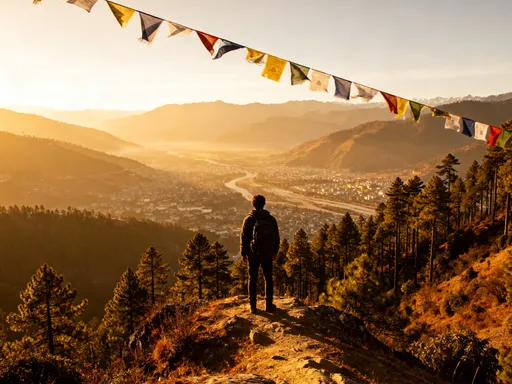
At the top of the ridge, the view opens to the full breadth of central Thimphu. The Wang Chuu River glimmers below, flanked by terraced fields and clusters of white-washed houses with red-tiled roofs. Temples like the Tashichho Dzong—home to Bhutan’s government and monastic body—rise prominently against the hills, their golden spires catching the sunlight. From this vantage, one sees not just the physical layout of the city, but its spiritual spine. The placement of temples, the orientation of prayer wheels, the alignment of paths—all reflect a deep cultural commitment to balance and mindfulness.
This viewpoint is especially powerful at dawn or dusk, when the low-angle light paints the valley in warm gold and soft violet. At these times, the sound of temple bells drifts upward, mingling with the distant murmur of the river. The city feels both alive and profoundly still—a rare duality that captures the essence of Bhutan. For the traveler, this spot offers more than a photo opportunity; it provides a window into the rhythm of daily devotion, not as performance, but as a natural part of life. There are no entrance fees, no ticket booths, no loudspeakers—just space, silence, and the quiet hum of faith in motion.
Kuensel Phodrang: The Buddha That Watches Over All
Rising 163 feet above the hillside at 2,550 meters, the Buddha Dordenma statue at Kuensel Phodrang is one of Bhutan’s most iconic landmarks. Gilded and serene, the seated figure of Shakyamuni Buddha gazes across the Thimphu Valley with eyes that seem to follow visitors wherever they go. Constructed in the early 21st century, the statue was commissioned as a symbol of peace and prosperity and is believed to fulfill a prophecy dating back to the 8th century. Its presence is awe-inspiring, not through grandiosity, but through its quiet, unwavering calm.
The site is accessible by a paved road or a forested hiking trail, both leading to a large viewing platform at the base of the statue. From here, the entire valley unfolds in a sweeping panorama—patchwork fields, winding roads, and distant peaks that fade into the horizon on clear days. The statue itself is hollow and contains over 100,000 smaller Buddha statues, ranging in size from one centimeter to several feet tall. Each was brought from Nepal and installed with ritual care, making the structure not just a monument, but a sacred vessel of devotion.
What makes Kuensel Phodrang more than a photo stop is the atmosphere it cultivates. Despite its popularity, the site maintains a meditative quality. Visitors walk slowly, speak in hushed tones, and often pause to meditate or offer prayers. The surrounding complex includes a small museum, a cafeteria, and walking paths lined with prayer wheels, but these amenities are modest and unobtrusive. The focus remains on the statue and the view it commands.
Morning light is particularly beautiful here, softening the contours of the hills and illuminating the golden face of the Buddha with a gentle glow. Afternoon brings sharper contrasts, with long shadows stretching across the valley. To avoid crowds, it is best to arrive early in the day. Even when others are present, the scale of the landscape ensures a sense of personal space. Families often visit together, with elders explaining the significance of the statue to younger generations. For the solo traveler, especially women in the 30–55 age group seeking meaningful, reflective experiences, Kuensel Phodrang offers a rare combination of grandeur and intimacy—a place where one can feel both small and deeply connected.
Langchenphu Caves: Whispers of the Ancients
Nestled in the northern reaches of Thimphu, hidden behind thick foliage and rarely marked on tourist maps, the Langchenphu Caves are a testament to Bhutan’s deep spiritual history. The path to the caves follows a narrow trail beside a clear mountain stream, which tumbles over smooth stones and feeds into the Wang Chuu River below. The climb is modest but requires attention—roots cross the path, and the terrain can be slippery after rain. Yet the journey is part of the experience, a gradual withdrawal from the world of noise and into one of quiet reverence.
At the top, the caves emerge from the rock face—small, dark openings carved by nature and later shaped by human hands. These were once used by hermit monks for long-term meditation retreats, sometimes lasting years. Inside, the air is cool and still, and the silence is nearly absolute. Simple altars hold butter lamps and offerings of rice and flowers, left by pilgrims who still visit for prayer and reflection. There is no lighting, no signage, no guided tours—just the raw presence of history and devotion.
The view from the cave entrance is understated but powerful. It overlooks the upper Thimphu Valley, where the land is less developed and more wild. Terraced farms cling to steep slopes, and smoke rises from distant chimneys. On clear days, the snow-dusted peaks of the surrounding range catch the morning sun. Unlike more popular viewpoints, this one feels untouched by tourism. There are no souvenir stalls, no benches, no railings—only nature and the echoes of centuries of quiet practice.
This spot is not for those seeking comfort or convenience. It is for travelers who value depth, solitude, and a sense of discovery. The lack of infrastructure is not a flaw but a feature—it preserves the authenticity of the place. A light jacket is advisable, as the wind at this elevation can be sharp, and the silence, though peaceful, can feel almost physical in its intensity. For the mindful visitor, the Langchenphu Caves offer a rare gift: a chance to stand where few have stood, to breathe the same air as those who came before, and to listen—to the wind, to the stream, and to the quiet voice within.
The Northern Ridge Trail: Off-Grid Majesty
Extending beyond the well-trodden paths of Thimphu, the Northern Ridge Trail offers a journey into the heart of Bhutan’s living landscape. Accessible via a small village lane off the main road to Punakha, this trail follows an ancient herder’s path along a high ridge that runs north of the city. The ascent is gradual, allowing hikers to acclimate while enjoying uninterrupted views of forested slopes and distant valleys. This route is rarely included in standard tour itineraries, which means long stretches of pure solitude—a rare luxury in any travel destination.
The terrain is stable but uneven, with rocky sections and exposed roots that demand good hiking shoes. The trail passes through mixed forests of oak, maple, and fir, where birdsong fills the air and wildflowers bloom in spring. Midway, a small stone shrine appears beside the path, adorned with prayer flags and fresh offerings of incense and rice. This is a resting point for locals, a place to pause and honor the spirit of the land. It also serves as a reminder that this trail is not just a recreational path, but a cultural corridor with ongoing significance.
At its highest point, the ridge opens to a westward panorama that stretches for miles. On clear days, the snow-capped peaks of the Black Mountains rise in the distance, their summits glowing in the afternoon light. Below, the valley remains green and fertile, with small farms and grazing yaks dotting the hillsides. The sense of being off-grid is profound—there is no cell signal, no noise from vehicles, no trace of commercial development. It is just you, the wind, and the vast, quiet beauty of the Himalayas.
What sets this trail apart is its authenticity. Unlike curated viewpoints, this is a landscape shaped by time, tradition, and the rhythms of rural life. It invites a slower, more reflective way of moving through space. Hikers often report a sense of mental clarity and emotional calm, as if the altitude and silence work together to cleanse the mind. For women travelers seeking a safe, meaningful, and physically accessible adventure, the Northern Ridge Trail offers a perfect balance of challenge and reward. It is not about conquering a summit, but about reconnecting—with nature, with culture, and with oneself.
Why High Ground Shapes the Traveler
The viewpoints around Thimphu do more than offer scenic rewards—they transform the way we see and feel. Standing above the valley, one begins to perceive patterns that are invisible at ground level. The slow pace of life, the integration of spirituality into daily routines, the careful balance between development and preservation—all become clearer from a higher vantage. These places do not just display beauty; they teach it. They invite stillness, presence, and a deep respect for a culture that values harmony over haste.
For the traveler, especially one seeking meaningful experiences beyond the surface, these high places offer a rare opportunity. They ask not for admiration, but for openness. To fully receive what they offer, one must come with more than a camera—curiosity, patience, and a willingness to listen are essential. Visiting at quiet hours, dressing modestly, and treading lightly are small acts of respect that enhance the experience. In Bhutan, where Gross National Happiness is a guiding principle, even tourism is an act of mindfulness.
The physical act of climbing—whether to a monastery, a ridge, or a cave—mirrors an inner journey. Each step upward is a release of distraction, a shedding of mental clutter. At the top, the view is not just of the land, but of a different way of being. One returns to the valley floor changed—not dramatically, but subtly, with a quieter mind and a fuller heart. The noise of daily life may resume, but the memory of stillness remains.
Thimphu’s high viewpoints are not just destinations; they are invitations—to see deeply, to move gently, and to carry a piece of Bhutan’s soul into the world. In a time when travel often means rushing from one highlight to the next, these places remind us that the most lasting journeys are those that move us from within. So pack your water, lace your shoes, and begin the climb. Above the valley, peace is waiting.